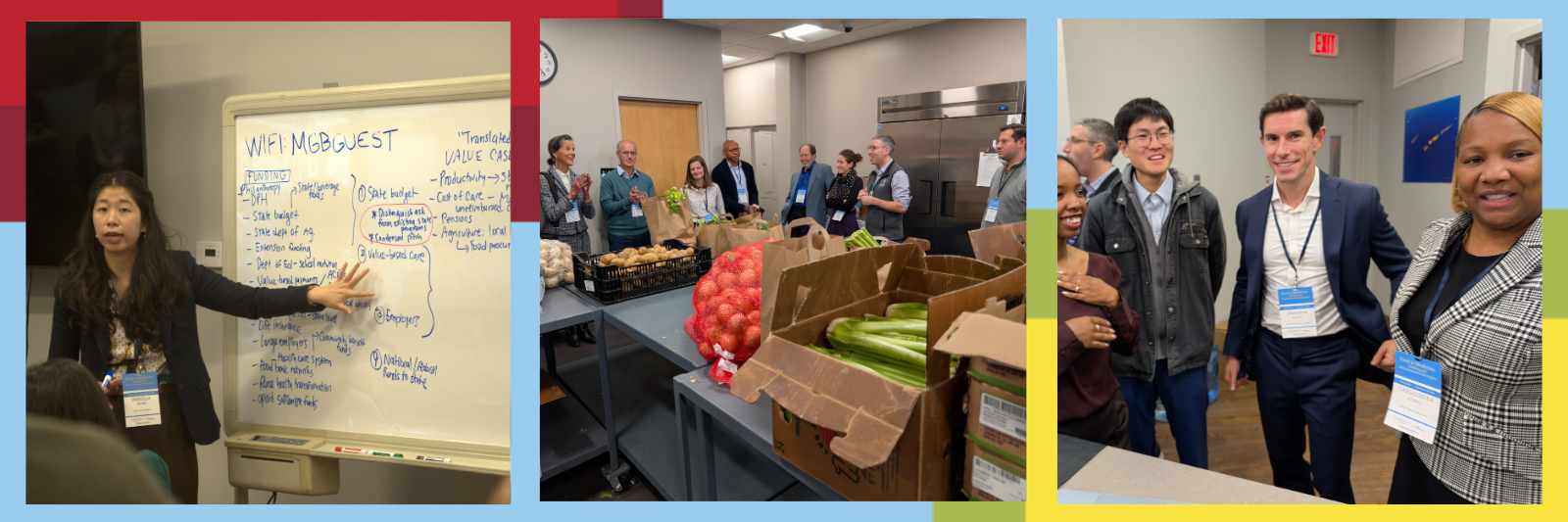
Food & Society at the Aspen Institute convened an intimate gathering of community-based organizations, researchers, practitioners, and policymakers at the MGH Revere’s Teaching Kitchen in Boston, MA. The workshop focused on how Food is Medicine programs finance their operations today and what funding strategies can sustain them over the long term.
Food is Medicine programs have expanded rapidly over the past decade, moving from small pilots to widespread implementation across healthcare systems, community organizations, and state Medicaid programs. The growing field also brings more uncertainty about how people will sustain it.
Several urgent questions now shape conversations among practitioners, policymakers, and funders: How sustainable is it to rely on Medicaid 1115 waivers? Where is Food is Medicine funding coming from today, and where will it come from tomorrow? What strategies offer the greatest promise in an increasingly constrained fiscal environment?
The five themes below reflect the key insights that emerged from this convening.
Theme One: A Fragmented but Functional Funding Landscape
Food is Medicine programs rarely receive financing from a single, predictable reimbursement stream, regardless of geography or intervention type. Instead, programs rely on braided funding models that weave together public, private, and philanthropic dollars.
Medicaid 1115 waivers and managed care authorities support some medically tailored meals and groceries for narrowly defined populations. Medicare Advantage plans may cover short-term meals or food benefits for chronically ill members. Health systems often contribute operating dollars, particularly in states without waivers. Philanthropy and research grants fill remaining gaps and support innovation.
This fragmentation has enabled rapid growth and experimentation, but it has also created structural vulnerability. Programs that invest in kitchens, staff, and delivery infrastructure remain exposed to reimbursement delays, shifting eligibility rules, and policy changes. The risk is not inherent to any single funding source but reflects overreliance on arrangements that may be politically and administratively unstable.
Theme Two: Competing Conceptions Shape Funding Pathways
One of the central tensions in Food is Medicine today is that the field operates under two distinct concepts of what these interventions achieve. Each lead to different funding pathways and expectations.
The first treats Food is Medicine as medical treatment, targeting individuals with serious chronic diseases or high healthcare utilization and justifying interventions through near-term clinical outcomes and cost savings. This pathway aligns naturally with Medicaid 1115 waivers, Medicare Advantage supplemental benefits, and value-based payment models.
The second treats Food is Medicine as long-term population health infrastructure, emphasizing prevention, resilience, and economic stability. Benefits in this framing accrue over longer time horizons and are less easily captured through traditional healthcare return-on-investment metrics.
The challenge is that these two concepts often coexist within the same programs and funding conversations, leading to incompatible expectations that undermine both sustainability and scale. Recognizing them as distinct and legitimate pathways is critical for the field.
Theme Three: Commercial Payers and Employers Must Be Engaged
For Food is Medicine to move beyond heavy reliance on public programs, engagement with private insurers and employers is essential. These stakeholders operate under different incentives than public health or anti-hunger systems, prioritizing risk management, cost containment, and competitive performance.
To gain traction in private markets, stakeholders must frame Food is Medicine in payer- and employer-relevant terms, highlighting reduced hospitalizations, improved medication adherence, stabilization of high-risk members, lower total cost of care, and workforce outcomes like productivity and absenteeism.
Food is Medicine interventions are frequently held to evidentiary standards that exceed those applied to many covered pharmaceuticals or procedures, creating barriers for prevention-oriented models whose benefits accrue over longer time horizons. Private-sector funding’s future role depends less on whether these interventions work and more on how their value communicates in the language of risk, cost, and performance.
Theme Four: Federal Signals, Medicaid Limits, and the Budget Squeeze
Medicaid has driven Food is Medicine growth over the past decade, primarily through Section 1115 waivers and managed care authorities, while Medicare Advantage has expanded coverage for nutrition-related benefits. But recent federal health and budget legislation has narrowed the policy space. Changes to Medicaid financing have reduced states’ flexibility to fund optional services, and new SNAP requirements have increased administrative burden and constrained state capacity.
Against this backdrop, attention has turned to pending 1115 waiver decisions in Washington, DC, Maine, and Nevada as indicators of federal direction. Yet even approved waivers typically serve limited populations and remain vulnerable to policy changes.
Recent developments in Oklahoma and Texas illustrate the limits of federal reliance. Oklahoma has focused on food-based interventions through state appropriations and existing public health and agriculture funding, while Texas has advanced such interventions through state legislation after an initial narrowing. Together, these cases show that in non-waiver states, the future of Food is Medicine depends on states’ willingness to embed food-based interventions within their own budgets and policy priorities.
Theme Five: State and Local Capacity to Mobilize Funding
Despite federal uncertainty, significant opportunities exist at the state and local levels. Many funding streams already align with Food is Medicine goals: state budgets, departments of agriculture and extension, public health agencies, school nutrition programs, opioid settlement funds, and insurance dollars.
The obstacle is their fragmentation across silos. Aligning these streams requires coordination, shared framing, and coalition-building. State and local organizations are uniquely positioned to do this work: translate Food is Medicine into concrete outcomes that resonate with policymakers, including local economic impact, workforce stability, and constituent benefit.
Cross-sector coalitions that unite healthcare, anti-hunger, agriculture, and workforce stakeholders are especially effective in advancing shared funding priorities and breaking down the institutional barriers that keep existing resources from reaching Food is Medicine programs.
What Sustaining Food is Medicine Will Require
Taken together, these five themes point to several strategic imperatives for the field:
- Clearly define interventions as treatment-oriented or infrastructure-oriented, with funding and evaluation aligned accordingly.
- Reduce reliance on Medicaid waivers by expanding engagement with Medicare Advantage, employers, private insurers, and state budgets.
- Frame outcomes in terms that resonate across funding systems, clinical, economic, and workforce, while preserving public health goals.
- Prioritize durable infrastructure that persists beyond individual funding cycles.
- Coordinate across state and local funding streams to break down silos and mobilize existing resources more effectively.
Food is Medicine is no longer experimental. The future of these programs will depend less on any single policy decision than on the field’s ability to clarify its pathways, translate value across funding systems, and coordinate investments across health, food, and economic sectors. Sustained progress will require aligning ambition with financing strategies durable enough to withstand political and fiscal changes.
